
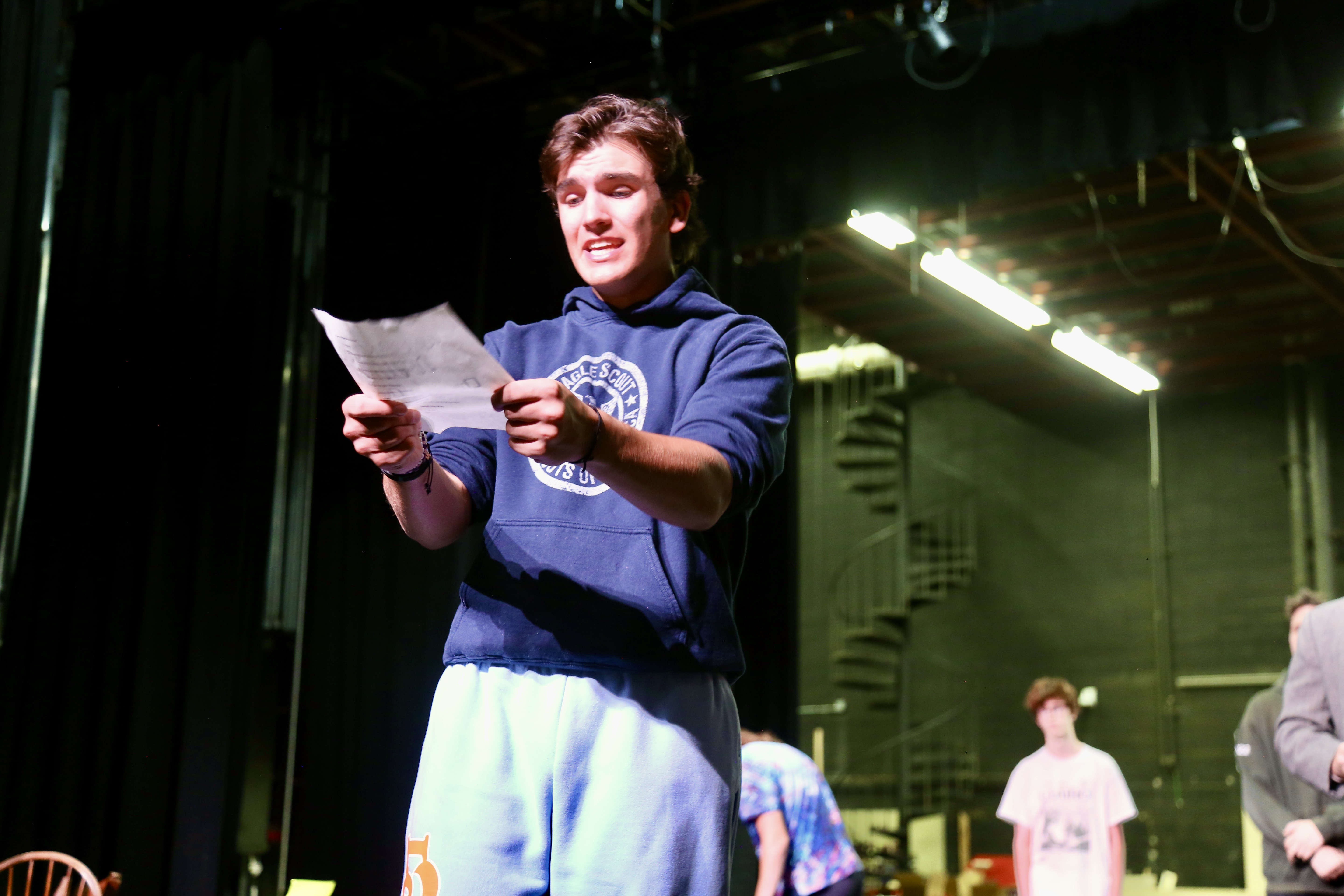
My name is Matthew Seiberlich. I am a senior (scary). Outside of theater, I am President of the Wisconsin Junior Classical League, President of the Film Club, Junior Assistant Scoutmaster for Boy Scout Troop 865, Vice-President of the Student Council, a lacrosse player, a history nerd, and a fisherman.
In The Crucible, I play John Proctor, a farmer and husband to Elizabeth. He’s known around town for his good name, but there’s more to him that lies beneath the surface. Proctor is an interesting character, and the depth and emotions he conveys have really pushed my acting abilities to the brink. It’s such a fun challenge, and I have loved every second of it.

What brought you to join the cast, crew for The Crucible?
The Crucible is one of my favorite plays of all time. I think there has yet to be a writer who matches the character development and thematic drama that Arthur Miller brings to the theater world. I had already read The Crucible three or four times when it was announced as the fall show. I was so excited, and I had no choice but to audition.
Do you have any stories from rehearsals, practices or crew sessions?
One of my favorite stories is doing improv during the first few rehearsals. We acted out trials that aren’t shown in the play but are referenced. One of these trials was for Sarah Good, and John was not at that trial. But there was a reference to Dr. Griggs. So I asked Figg if I could be Dr. Griggs, and then went into the improvised scene with a really dumb half-Canadian and half-Irish accent and played Dr. Griggs. When I say played, I mean I just rambled about random medical terms and tried to make my friends laugh. It was so much fun, and that interaction between actors is my favorite part of theatre.

All art comments on something, it aligns itself with current issues. How does this work comment on current social or political issues and has it influenced you?
Arthur Miller was one of the most famous victims of the Second Red Scare. During the Cold War, American politicians (most famously, Joe McCarthy) accused many writers, musicians, and activists of being communists in order to silence their opponents and gain political power for themselves. Miller wrote The Crucible as a warning against this and a criticism of Joe McCarthy and his scare tactics. People went along, whether it was out of fear, for their own gain, or groupthink. That is what the play reflects on; fear, greed, and groupthink. The witchcraft portrayed in the show is no different than the communism of real life. It is a tool for gaining power. Unfortunately, this pattern of fear, greed, and groupthink is still prevalent in today’s political landscape, so I think the show remains a relevant metaphor for politics in America.
What do you hope the audience will be thinking about in the car as they drive home after this show?
I hope it gets them to think about the world. What do we deem as right or wrong, and what do we stand by and watch happen? Miller wrote the show as a warning against blind hatred and groupthink, and I hope people recognize the underlying messages behind it.
What’s one thing that is different in this play or rehearsal process than anything else we’ve done in the Homestead Theatre Department?
The main thing has been characterization. The number of character walks, research into our historical counterparts, and improvised scenes have not been seen in any other show I have participated in. The research, especially, has been a unique aspect of The Crucible. We spent an entire rehearsal reading up on the real players of the Salem Witch Trials that our characters are based on. We then compared them to our characters and used them to build and understand the characters we were playing. It was a very enlightening experience and really helped me gain a better understanding of Proctor.

 Act Out